
MAHAN'S VERDICT
How Xi Jinping mastered the doctrine America wrote — and what it will cost us

Part I of V: The Book, the Student, and the Map
“History and experience tell us that a country will rise if it commands the oceans well and will fall if it surrenders them.”— Xi Jinping, Chinese state policy
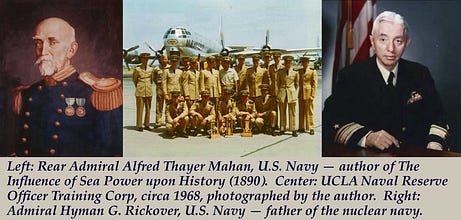
“The man in charge must concern himself with details. If he does not consider them important, neither will his subordinates.” — Admiral Hyman G. Rickover, U.S. Navy
“The power to insure communications to one’s self, and to interrupt them for an adversary, affects the very root of a nation’s vigor.” — Captain Alfred Thayer Mahan, U.S. Navy, The Influence of Sea Power upon History, 1890
About This Series
This five-part series examines how President Xi Jinping systematically adopted and executed the sea power doctrine that a United States naval officer prescribed for American greatness; a greatness America achieved under that doctrine and then spent the next sixty years dismantling by neglecting to maintain its requirements. The doctrine, the framework, is Alfred Thayer Mahan’s The Influence of Sea Power upon History (1890). The verdict, on China and on the United States, is his to render.
Part I — The Book, the Student, and the Map: The doctrine stated. The man who institutionalized it in China identified.
Part II — The Trap and the Anti-Mahanian Presidency: How the Iran war became the chokepoint that drove Trump to Beijing — and how three pillars of American sea power are being systematically dismantled.
Part III — Beneath the Waves: The one dimension of American sea power that Rickover built too well to be easily destroyed — and what it tells us about recovery.
Part IV — The Global Chessboard and The Erosion: How Xi manages the global architecture of power actor by actor — and the seven-phase history of how America forgot what it wrote.
Part V — The Voices, The Projection, The Verdict, and The Recovery: What American institutions are saying about the crisis, where the three pillars stand by 2029, and what it will cost to rebuild them.
Part VI (Addendum) — Complete References: All endnotes consolidated by Part for researchers and readers who want the full sourcing.
A link to the next part appears at the end of each installment.
PROLOGUE — Shifting Tides: The Fall of American Sea Power and the Rise of China
In the fall of 1965, a young Naval officer in training at UCLA opened a book that the United States Navy had decided every officer needed to understand. Not as history. Not as theory. As doctrine — the intellectual architecture of the oath being taken and the service being prepared for.
The book was The Influence of Sea Power upon History, published in 1890 by Captain Alfred Thayer Mahan, U.S. Navy.1 Its argument was deceptively simple: national greatness is inseparable from maritime power. The nation that commands the oceans commands the trade routes. The nation that commands the trade routes commands the wealth of the world. And the nation that commands the wealth of the world commands the world itself. Three pillars sustain this architecture — commerce, naval strength, and bases — each reinforcing the others in a self-compounding cycle that, once established, is almost impossible to displace.
It was 1965. The Cold War was at full tide. The USS Enterprise — the Navy’s first nuclear-powered aircraft carrier — had just struck Viet Cong targets near Biên Hòa, the first nuclear-powered warship ever to engage in combat.2 The Seventh Fleet patrolled waters that Mahan had mapped, seventy-five years earlier, as strategically indispensable.3 Beneath those same waters, American nuclear submarines ran silent patrols that no adversary could detect or counter — the invisible foundation of the visible fleet, the deepest expression of the doctrine being studied on shore.
American sea power was at its absolute zenith. The book felt less like history than like a description of the present — a map of the world the Navy existed to defend, written by an officer who understood that world before it fully existed.
Vietnam was on the horizon. So was everything that followed.
At the eve of his commissioning that officer in training also crossed another threshold. He sat across a desk from Admiral Hyman G. Rickover — the man who had spent seventeen years building the nuclear navy from nothing, who personally interviewed every officer who would serve in his program, who had driven standards of technical excellence and personal accountability that no institution in American public life has equaled before or since.4 Rickover had accepted him. He would go on to complete the nuclear power program and serve aboard a submarine in the Atlantic, part of the silent fleet whose patrols kept the Cold War cold.
He also carried Mahan’s work. Not literally — but in the way that a foundational text stays with one who absorbed it at the moment of maximum receptivity, when the ideas on the page are not abstractions but the organizing principles of a life being constructed. Mahan was not assigned reading. Mahan was the map.
Now, sixty years later, that map describes a world in crisis.
After military service, that young officer carried Rickover’s principles of technical excellence into civilian service as a nuclear engineer performing reactor refueling and maintenance on U.S. Navy submarines and aircraft carriers where he witnessed first hand how the Navy’s propensity to defer maintenance, shortening the life cycle of ships and shifting an unmanageable workload onto future years, contributed to the dismantling of the second pillar of Mahan’s thesis, naval strength.5
That thesis now applies not to American ascendancy but to American abdication — and simultaneously to the leader of the world’s rising sea power, who has quoted Mahan’s core argument almost verbatim as Chinese state policy6, and who spent the last week in Beijing receiving the president of the United States the way a creditor receives a borrower who has run out of alternatives.
Two days after that president departed, Vladimir Putin arrived — to sign forty bilateral agreements, issue a joint declaration on a multipolar world, and collect from Xi Jinping the strategic reassurance that Moscow could not obtain from anyone else on earth.7
Beijing hosted both presidents in the same week and to both Xi presented the exact same message. During the U.S.-China summit, he utilized the concept of the “Thucydides Trap”—the theory that a rising power and an established hegemon are destined for conflict—to urge Donald Trump to manage the global power shift with civility and minimal strife. Similarly, during his summit with Vladimir Putin, Xi framed the U.S. and Russia as declining empires, and positioned China as the disciplined center of a new global order.
This is not a partisan argument. Mahan was not a Democrat or a Republican. He was an American naval officer whose doctrine built the greatest maritime power in the history of the world. Rickover was not a politician. He was an engineer who demanded perfection and got it — whose nuclear navy has compiled a safety record across more than six thousand reactor-years of operation without a single accident.8 Using their framework to assess the current moment is not political commentary. It is strategic accountability measured against American strategic tradition — which is, in the end, the hardest possible standard to dismiss.
A note on timing: The events examined in this series were developing rapidly as it was being written. In every case, those developments confirmed rather than complicated the central thesis. The Beijing summits of May 2026 — first Trump’s, then Putin’s — unfolded precisely as the Mahanian framework predicts they would. This analysis will stand as written. If subsequent events warrant a separate assessment, it will appear as a follow-on piece.
The verdict Mahan would render — on Xi, on Trump, on the institution that still bears Mahan’s name, and on the one dimension of American sea power that Rickover built too well to be easily destroyed — is the subject of what follows.
SECTION I — THE DOCTRINE
The argument that U.S. Navy captain Alfred Thayer Mahan published in 1890 was so clear and so consequential that it immediately rewired how every major power on earth thought about national strategy.
Mahan’s thesis rested on three pillars, each one necessary, none sufficient alone.
The first pillar is commerce. A nation’s prosperity depends on seaborne trade — the movement of goods, raw materials, and finished products across the world’s oceans. The nation that protects and expands its commercial maritime reach accumulates the wealth that funds everything else. Mahan observed that Britain’s centuries of dominance were built not merely on its navy but on the merchant fleet that preceded and funded the navy — the commercial foundation that made the warships possible and gave them purpose.
The second pillar is naval strength. Commerce generates wealth, but wealth without protection is simply an invitation to predation. A powerful navy secures the sea lanes that commercial shipping depends on, projects power in peacetime to deter rivals, and in wartime destroys the enemy’s fleet to establish what Mahan called “command of the sea” — the condition in which one nation’s ships move freely while the enemy’s cannot. The decisive instrument, in Mahan’s framework, is the battle fleet: concentrated, offensive, capable of meeting and defeating the enemy’s fleet in open battle and thereby settling the question of maritime dominance at a stroke.9
The third pillar is bases. A navy cannot project power into distant waters without a network of ports, coaling stations, and logistical nodes positioned across the ocean. Without bases, a fleet is tethered to its home waters — powerful in its own neighborhood, irrelevant everywhere else. With bases, a fleet commands the ocean. Mahan studied the British Empire’s network of strategic bases — Gibraltar, Malta, Aden, Singapore, Hong Kong — and understood that they were not imperial ornaments. They were the architecture of sea power itself, the infrastructure that converted naval strength into global reach.10
These three pillars are mutually reinforcing in a cycle that, once established, is almost impossible to break. Commerce generates the wealth that funds the navy. The navy protects the commerce and projects power from the bases. The bases extend the navy’s reach, which protects more commerce, which generates more wealth. The nation that commits to all three simultaneously and sustains that commitment across generations does not merely become powerful. It becomes dominant — the default anchor of the global order, the power whose preferences shape the rules, whose currency funds the system, and whose navy enforces the peace.
Mahan was not describing an abstraction. He was describing Britain in 1890, at the height of its imperial power, and prescribing for America what Britain had achieved. His book was a strategic manual for a nation he believed was ready to take Britain’s place — if it had the wisdom to build the commercial, naval, and basing infrastructure that greatness required.
The book’s impact was immediate and global. Theodore Roosevelt read it and began building what would become the American battle fleet.11 Kaiser Wilhelm II read it and launched the German naval buildup that contributed directly to World War I.12 Japan’s naval leadership read it and built the Imperial Navy that struck Pearl Harbor.13
One more reader absorbed the text with particular care. Not an American. Not a European. A Chinese admiral named Liu Huaqing, who would spend the following four decades building the institutional foundation for what Xi Jinping is now executing.14
Mahan died in 1914, one month after the war whose naval arms race he had helped inspire broke out in Europe. He did not live to see American sea power reach the dominance his prescription envisioned. He did not live to see it begin to erode. And he did not live to see the nation that most completely absorbed his lesson use it to displace the nation that wrote it.
But he would not have been surprised. The thesis predicts exactly this. It always has.
SECTION II — THE STUDENT
In June 2025, at the Naval War College’s 74th Current Strategy Forum — the institution Mahan helped found, the institution that still bears his intellectual legacy — retired Admiral James Foggo, dean of the Center for Maritime Strategy, delivered a keynote on Mahan’s enduring relevance. He said it plainly: “Xi Jinping has read Mahan and he subscribes to it. It’s time to bring Mahan and sea power back.”15
That statement deserves a moment of stillness.
The dean of the Center for Maritime Strategy, speaking at Mahan’s own institution, confirmed that the leader of America’s primary strategic rival has absorbed and is executing the doctrine that an American naval officer wrote to prescribe American greatness. The institution that trained generations of U.S. Navy officers in Mahan’s framework is now using that framework to describe what China is doing to America.
The transmission line runs through Liu Huaqing. When Liu became Commander of the People’s Liberation Army Navy in 1982, China’s naval forces were a coastal defense force — brown-water, limited range, strategically irrelevant beyond China’s immediate shoreline. Liu had studied Mahan. He had studied Corbett.16 He understood that China’s geography — vast coastline, dependence on seaborne trade, proximity to critical chokepoints — made maritime power not merely useful but existentially necessary.
Liu developed what he called the “island chain” strategy: a progressive expansion of China’s naval defensive and offensive perimeter from the first island chain — the arc from Japan through Taiwan to the Philippines — to the second island chain extending to Guam and the Marianas, and ultimately to global blue-water reach.17 This was not improvised. It was Mahan applied to Chinese geography across a multi-decade timeline — the kind of patient, generational strategic planning that Mahan had identified as the prerequisite for sea power dominance
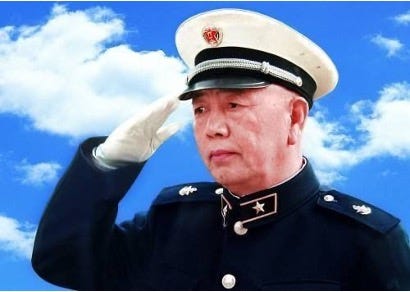
Xi Jinping inherited Liu’s institutional framework and accelerated it into the most comprehensive Mahanian buildout since the United States itself in the post-World War II era. He has executed all three pillars simultaneously, with a discipline and consistency that has no parallel in the modern democratic world.
Commerce — The Belt and Road as Mahanian Strategy
Mahan argued that commercial dominance precedes and funds naval dominance. China’s Belt and Road Initiative — the most ambitious infrastructure investment program in human history — is Mahanian commercial strategy at civilizational scale.18 Across more than 140 countries, China has financed and built the port infrastructure, rail connections, energy pipelines, and digital networks that make Chinese maritime commerce the organizing principle of global trade. China’s merchant fleet — more than 5,500 vessels in international commerce — dwarfs the American merchant marine, which has declined to fewer than 80 ships flying the U.S. flag in international trade.19
Naval Strength — The PLAN and the Shipbuilding Revolution
By 2020, the People’s Liberation Army Navy had surpassed the United States Navy in total ship count — 350 surface ships and submarines against the U.S. Navy’s 293.20 By the end of 2026, the PLAN is projected to reach 395 warships. By 2030, 435. China’s shipbuilding capacity now represents approximately 45 to 50 percent of global output.21 The United States accounts for 0.1 percent. Senator Mark Kelly — retired Navy captain, member of the Senate Armed Services Committee — stated this directly in congressional testimony: “U.S. overall commercial shipbuilding is 0.1% of global capacity. China enjoys over 50% of global shipbuilding capacity. Regaining that is absolutely essential for our defense in the 21st century.”22
Bases — The String of Pearls
China’s first acknowledged overseas military base opened in Djibouti in 2017.23 Across the Indian Ocean rim — Gwadar in Pakistan, Hambantota in Sri Lanka, Kyaukpyu in Myanmar, Ream in Cambodia — China has invested in commercial port infrastructure that carries unmistakable dual-use military potential.24 The South China Sea artificial islands, militarized despite international legal rulings, extend China’s forward basing perimeter into waters through which $3 trillion in annual trade flows.25
The Declaration
Xi has not been subtle about what he is building or why. He has stated it in terms Mahan would have recognized as his own: “History and experience tell us that a country will rise if it commands the oceans well and will fall if it surrenders them. We must adhere to a development path of becoming a rich and powerful state by making use of the sea.”
That is not paraphrase of Mahan. That is Mahan translated into Mandarin and delivered as Chinese state policy. Naval War College scholars have given this a name: the neo-Mahanian standard.26 The student has not merely read the text. He has made it the constitution of Chinese maritime power.
J.R. Kineman is a national security analyst, investigative journalist, and U.S. Navy veteran. He publishes at jrkineman.substack.com. Press inquiries: press@jrkineman.com. Follow on X: @Jkineman.
→ Continue to Part II: The Trap and the Anti-Mahanian Presidency
Alfred Thayer Mahan, The Influence of Sea Power upon History, 1660–1783 (Boston: Little, Brown, 1890). Full text available free through Project Gutenberg: https://www.gutenberg.org/ebooks/13529
USS Enterprise (CVN-65) was commissioned November 25, 1961. Aircraft from Enterprise conducted the first combat operations by a nuclear-powered warship on December 2-3, 1965, striking Viet Cong targets near Biên Hòa, South Vietnam. National Naval Aviation Museum: https://www.naval-air.org/uss-enterprise
U.S. Seventh Fleet official history: https://www.c7f.navy.mil/About/History/
Admiral Hyman G. Rickover (1900-1986) served 63 years on active duty — the longest in American naval history. His farewell congressional testimony, January 28, 1982: https://www.jec.senate.gov/reports/97th%20Congress/Economics%20of%20Defense%20Policy%20-%20Adm.%20H.%20G.%20Rickover%20Part%20I%20(1110).pdf. Rear Admiral Dave Oliver, USN (Ret.), Against the Tide: Rickover's Leadership Principles and the Rise of the Nuclear Navy (Naval Institute Press, 2014): https://www.usni.org/press/books/against-tide
Martin, Bradley; Michael McMahon, et al.: A Strategic Assessment of the Future of U.S. Navy Ship Maintenance — Challenges and Opportunities; Rand Corporation, September 18, 2017.
https://www.rand.org/pubs/research_reports/RR1951.html
U.S. Naval War College Review, Implications of Xi Jinping’s “True Maritime Power”: https://digital-commons.usnwc.edu/nwc-review/vol68/iss3/4/
Putin arrived Beijing May 19, 2026. The visit produced 40 bilateral agreements and a joint multipolar world declaration. Moscow Times, Putin and Xi Sign ‘Multipolar World’ Declaration in Beijing (May 20, 2026): https://www.themoscowtimes.com/2026/05/20/putin-and-xi-sign-multipolar-world-declaration-in-beijing-a92796. Kremlin joint statement (primary Russian government source): https://kremlin.ru/supplement/6487
COMUSFLTFORCOMINST 4790.3, Joint Fleet Maintenance Manual, Volume V: https://www.navsea.navy.mil/Portals/103/Documents/SUBMEPP/Volume%20V.pdf. Donofrio, Don, "Rickover's Rules"(June 2023): https://www.thesnellgroup.com/featured-tips/rickovers-rules
Robert C. Rubel, "The Geopolitics of Sea Power," Naval War College Review (2012): https://digital-commons.usnwc.edu/nwc-review/vol65/iss3/5/
Mahan’s analysis of British basing strategy is developed throughout The Influence of Sea Power upon History and extended in The Interest of America in Sea Power (1897).
Edmund Morris, The Rise of Theodore Roosevelt (Random House, 1979). Roosevelt read The Influence of Sea Power upon History in manuscript before publication and wrote a laudatory review in the Atlantic Monthly.
Holger Herwig, “The Influence of A.T. Mahan upon German Sea Power,” in The Influence of History on Mahan(Naval War College Press, 1991). Kaiser Wilhelm II reportedly told his naval staff he was “trying to learn it by heart.”
David C. Evans and Mark R. Peattie, Kaigun: Strategy, Tactics, and Technology in the Imperial Japanese Navy(Naval Institute Press, 1997). Japanese naval officers translated The Influence of Sea Power upon History into Japanese in 1896.
The Diplomat, China’s Mahan: The Man Who Created China’s Modern Navy (May 2026): https://thediplomat.com/2026/05/chinas-mahan-the-man-who-created-chinas-modern-navy/. U.S. Naval Institute, China’s Mahan: https://www.usni.org/press/books/chinas-mahan
Naval War College 74th Current Strategy Forum report (June 2025): https://usnwc.edu/News-and-Events/News/Naval-War-College-Hosts-Forum-Discussing-China-Changing-Character-of-War. NPR/Center for Maritime Strategy interview with Foggo: https://centerformaritimestrategy.org/publications/retired-u-s-navy-admiral-on-trumps-threat-to-blockade-the-strait-of-hormuz/
Center for Maritime Strategy, China’s Mahanian Naval Strategy: https://centerformaritimestrategy.org/publications/chinas-mahanian-naval-strategy-and-why-america-needs-one-too/
U.S. Naval War College China Maritime Studies Institute, The Origins of “Near Seas Defense and Far Seas Protection”: https://digital-commons.usnwc.edu/cgi/viewcontent.cgi?article=1012&context=cmsi-maritime-reports
World Bank assessment of BRI: https://www.worldbank.org/en/topic/regional-integration/brief/belt-and-road-initiative
Senator Mark Kelly statement on merchant fleet, Senate Armed Services Committee hearing. U.S. Department of Transportation: https://www.transportation.gov/testimony/state-united-states-merchant-fleet-foreign-commerce
U.S. Department of Defense, Military and Security Developments Involving the People's Republic of China, Annual Report to Congress, 2024: https://media.defense.gov/2024/Oct/18/2003572132/-1/-1/1/2024-MILITARY-AND-SECURITY-DEVELOPMENTS-INVOLVING-THE-PEOPLES-REPUBLIC-OF-CHINA.PDF
Australian Naval Institute, The Rise of the Modern Chinese Navy (April 2026): https://navalinstitute.com.au/the-rise-of-the-modern-chinese-navy/
Senator Mark Kelly, SASC hearing on INDOPACOM posture. Kelly press release: https://www.kelly.senate.gov/newsroom/press-releases/watch-in-sasc-hearing-kelly-highlights-shipbuilding-crisis-and-autonomous-systems-in-the-pacific/
CSIS, China's Overseas Basing Ambitions: https://www.csis.org/china-overseas-basing
RAND Corporation, Chinese Military Basing Abroad: https://www.rand.org/chinese-military-basing. Hambantota port in Sri Lanka was leased to a Chinese state company for 99 years in 2017 after Sri Lanka could not service its Belt and Road debt.
U.S. Energy Information Administration:
https://www.eia.gov/todayinenergy/detail.php?id=65504
U.S. Naval War College Review, Implications of Xi Jinping's "True Maritime Power": https://digital-commons.usnwc.edu/nwc-review/vol68/iss3/4/